What Maritime Excellence Means for Seychelles and Why It Is Non-Negotiable | World Maritime Day, 24 September 2026
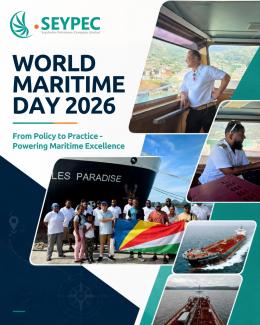
Today, as the world marks World Maritime Day, the International Maritime Organisation is focusing on a challenge that is straightforward in principle but far harder to achieve in practice: turning policy into action. The theme for 2026 and 2027, “From Policy to Practice - Powering Maritime Excellence,” is the first two-year theme chosen by the IMO, reflecting the need to translate international rules and standards into effective legislation, enforcement and everyday operations.
For Seychelles, this is particularly relevant. Though we are a small island state,we are not a small maritime state. Fuel reaches the countryy sea, while our Fisheries, Tourism and Blue Economy sectors depend on healthy and well-managed waters and our international trade depends on functioning maritime links. The people and institutions that regulate and support this system therefore carry responsibilities that extend well beyond the vessel itself. At SEYPEC, we see that responsibility every day.
What a changing industry means for a small island
The Shipping sector is undergoing significant change, driven by tighter environmental requirements, new technologies and a global move towards more efficient, lower-emission vessels. For SEYPEC, these developments cannot be viewed simply as international industry trends. They have to be considered alongside one fundamental responsibility. Keeping Seychelles supplied with energy safely and reliably.
That is one reason the company's fleet renewal programme matters. In July, the second of two new 41,000 DWT tankers was launched at Xiamen Shipbuilding Industry Co. Ltd. in China. The vessels are dual-fuel capable, designed to operate on conventional marine fuel and liquefied natural gas, and incorporate improved propulsion, cargo-management and fuel-efficiency technology.
As Chief Executive Officer Captain Adrian Mondon said at the launch, “This fleet renewal programme is about far more than replacing tankers. It is about positioning Seychelles for the future of international shipping by investing in modern, efficient and progressively more environmentally responsible vessels.”
For SEYPEC, therefore, modernisation is not simply about replacing older tankers. It is about ensuring that this national company can meet the standards of an industry that is changing rapidly, while continuing to fulfil its role. The IMO's greenhouse-gas strategy is already driving the sector towards significant emissions reductions, while negotiations on the proposed Net-Zero Framework continue internationally. For Seychelles, the challenge is to support that transition without losing sight of energy security. Those responsibilities have to move together.
Turning a safety plan into a response
The principle of moving from policy to practice is perhaps easiest to understand when something goes wrong. A safety procedure can be carefully written, approved and circulated, but its real value only becomes apparent when people have to rely on it. That is why emergency exercises matter. They allow organisations to test their plans while the consequences are still controlled, identify weaknesses and strengthen the communication and coordination that will be needed in a real incident.
In July, SEYPEC led a multi-agency emergency response exercise on Praslin involving the Seychelles Fire and Rescue Services Agency, Seychelles Police Force, the Disaster Risk Management Division and other stakeholders. The scenario involved a fuel-bowser fire on a public road. While the incident was simulated, the objective was practical: to test how people, procedures and agenciehs would work together during an actual emergency.
That is closely aligned with the focus of this year's IMO theme. International maritime rules only deliver their intended benefits when they are translated into effective action onboard ships, in ports and across the wider maritime sector. For Seychelles, this is particularly important because our geography means an incident involving fuel or maritime operations can quickly affect other agencies and communities beyond the immediate site. Preparedness, therefore, cannot rest with one organisation alone.
“Preparedness is not something you improvise in a crisis,” says Captain Mondon. The purpose of exercises such as the one on Praslin is to ensure that, when a response is required, the relationships, responsibilities and procedures are already familiar to the people expected to put them into action.
The people behind the standards
International maritime standards ultimately depend on people. Seafarers, port workers, ship operators, inspectors and administrators. For Seychelles, developing those people is therefore part of developing the maritime sector itself.
SEYPEC's investment in training and career development is one example. This year, the company welcomed home its Cohort 10 trainees, young Seychellois completing pre-sea training and beginning the next stage of their maritime careers. Earlier this month, SEYPEC also marked an important historic milestone when Vanessa Thomas became the first female Chief Officer in the company's fleet.
Her progression illustrates another dimension of policy becoming practice. National commitments to develop maritime expertise become meaningful when they create opportunities for Seychellois to build the knowledge and experience needed to take on greater responsibility.
A country can speak about developing national expertise for years. The more meaningful measure is whether those commitments ultimately produce Seychellois officers, engineers, captains and other maritime professionals equipped to lead and strengthen the sector.
Standards have to work in the Seychelles context
International maritime regulations are global, but their implementation are felt locally. Seychelles must develop the systems, expertise and institutions that work for our own circumstances and support our obligations as a maritime nation.
The Seychelles Maritime Safety Authority has responsibility for maritime safety and security, sustainable marine practices and the protection of marine ecosystems. In September, Cabinet also approved the establishment of a Seychelles Hydrographic Office within the Authority, strengthening national capacity in navigational safety, marine data, search and rescue and marine spatial planning.
These developments may not attract much public attention, but they form part of the infrastructure of a functioning maritime nation. So does the less visible work carried out every day by companies, seafarers, regulators and emergency agencies. The strength of the system is built through those many individual decisions, and through the ability of institutions to work together when it matters.
A maritime nation must think beyond the vessel
Shipping's future will involve new fuels, new technologies, changing regulations and higher expectations around environmental performance. For Seychelles, there is another dimension. We are an ocean nation.
The marine environment supports our economy, fisheries and identity. The standards governing shipping therefore have implications beyond compliance. They are connected to the environmental resource on which much of Seychelles' future depends, which is why maritime excellence cannot simply be measured by the number of conventions ratified or policies adopted. Those are important starting points, but their value lies in what follows.
What matters is whether vessels are operated safely, crews are properly trained, equipment is maintained, emergency responses are tested, environmental responsibilities are taken seriously and institutions have the capacity to enforce the standards expected of them. That is where policy becomes meaningful.
For SEYPEC, that work is already taking place through fleet renewal, investment in people, emergency preparedness and preparation to adapt to for the rapidly changing industry. For Seychelles, the task is to continue building on it.
We should not measure our maritime ambitions against the size of larger countries. We should measure them against the standards we expect of ourselves. A tanker arriving safely in Port Victoria may look like an ordinary part of national life, but behind that ordinary arrival is a network of people, systems, regulations, training and decisions that have to work together.
That is maritime excellence.
And perhaps that is the most useful way to understand this year's theme. ‘From Policy to Practice’ is about ensuring that the standards agreed internationally have a practical meaning here in Seychelles, on our vessels, in our ports and in the careers of the people who will carry our maritime sector forward.
For a country whose prosperity is so closely tied to the sea, that is not simply good maritime management.
It is responsible national development.